
Personal Responsibility: The FOUNDATION of Leadership

Updated: Nov 22, 2025
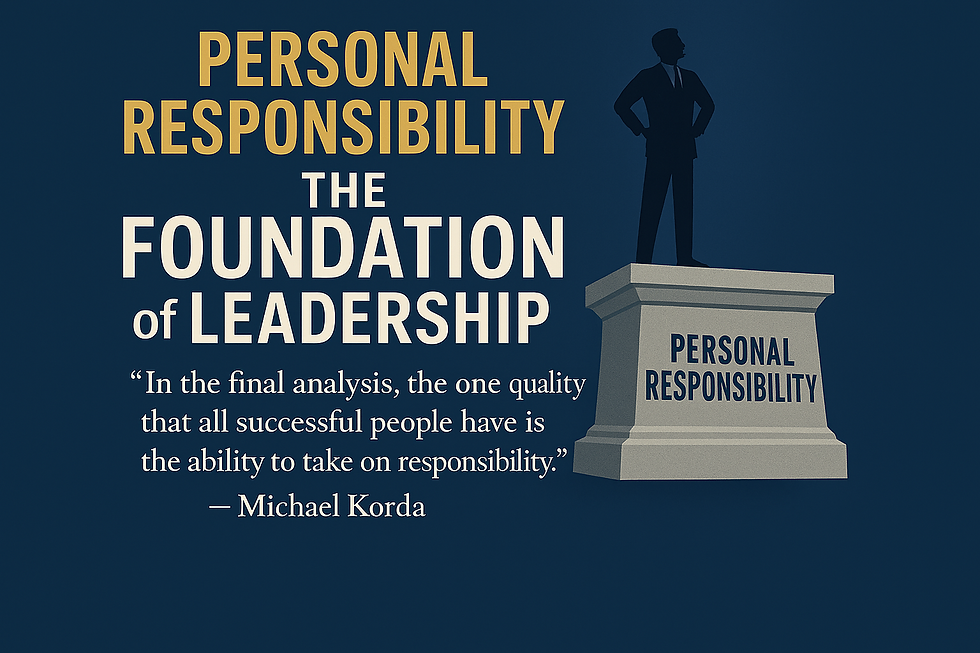
Not sure about you, but I have often thought about personal responsibility as an accountability measure…going back to being a little boy growing up in Tucson Arizona, I remember toiling over failure related to not making the mark in a number of ways. I remember crying in my room over bad grades, getting in trouble, not playing my best in whatever sport I was playing, etc. I felt this sense of personal responsibility before I really knew what it was. Felt this sense of ownership that nobody had to share.
Defining Personal Responsibility:
Personal responsibility is the acknowledgment and acceptance of the role one plays in shaping their own life. It involves being accountable for one's actions, decisions, and their consequences.
“Hence the skillful fighter puts himself into position which makes defeat impossible and does not miss the moment for defeating the enemy.” – Sun Tzu
My all-time favorite quote. Personal responsibility of not putting oneself or team in a situation where we might lose.
This concept is not merely about fulfilling obligations but about owning one's behavior, choices, and the outcomes that follow.
Why is personal responsibility critical?
The cornerstone of integrity and self-discipline. When individuals take responsibility for their actions, they build trust with others, develop resilience, and foster a sense of purpose to name a few.
Personal responsibility empowers people to take control of their lives rather than blaming external circumstances or other individuals for their shortcomings.
How is this tied to leadership?
Personal responsibility is intrinsically tied to leadership. True leadership begins with self-leadership, our ability to govern oneself before attempting to guide others. Leaders who embody personal responsibility set a powerful example. They demonstrate accountability, transparency, and reliability, which inspires their teams and cultivates a culture of trust and excellence. They simply put, can and will lead with influence.
Creating, developing, and fostering a greater sense of personal responsibility involves several key practices:
· First, self-awareness is essential. Individuals must reflect on their values, goals, and behaviors to understand their impact.
· Second, setting clear and realistic goals helps in aligning actions with desired outcomes.
· Third, embracing feedback and learning from mistakes promotes growth and accountability.
· Fourth, cultivating discipline through routines and commitments strengthens one's ability to follow through on responsibilities.
· Finally, surrounding oneself with supportive and responsible individuals can reinforce positive habits and attitudes.
Personal responsibility can be categorized in a few separate ways.
1. Behavioral Categories
i. I remember committing to trying to be the best football player I could be…writing out of my goals, visiting them often touched my heart different. I was accountable towards those. Often asked myself, “Am I making decisions that align with my goals?”
These focus on how personal responsibility manifests in actions:
Accountability: Owning outcomes of decisions and actions.
Reliability: Following through on commitments and being dependable.
Integrity: Acting in alignment with values, even when it's difficult.
Self-discipline: Managing impulses and staying focused on long-term goals.
2. Cognitive Categories
i. Remember being cut from the seahawks as a rookie and taking deep ownership in that. Was not mad at anyone. Asked myself if I had done what it took to make the roster? The following day I was signed to the team’s practice squad and used that as motivation to not feel like that ever again.
These relate to mindset and internal processing: How WE think…
Self-awareness: Recognizing one's role in successes and failures.
Growth mindset: Taking responsibility for learning and improvement.
Judgment: Making thoughtful decisions and accepting consequences.
3. Relational Categories
i. Had a coach who was so good at this…was so good to be around him. Feel like I really learned the value/power of this while being coached by him for several years. Simply put, he helped me grow in several ways.
These emphasize responsibility for interactions with others:
Respect for others: Acknowledging how one's actions affect others.
Communication: Being honest, clear, and responsive.
Empathy: Taking responsibility for emotional impact and relational dynamics.
4. Leadership & Organizational Context
i. Relates heavy to my time in city government. Dealt a series of poor leaders…the good ones stood out by making these areas super clear and touching them weekly.
Ownership of vision and mission: Aligning personal actions with organizational goals.
Modeling behavior: Demonstrating responsibility to influence others.
Feedback receptivity: Accepting and acting on constructive input. Knowing what you are receiving but also giving, i.e., feedback and/or criticism.
"Taking responsibility is not about admitting fault. It’s about owning your part in the outcome and choosing to lead forward."— Unknown.
In conclusion, personal responsibility is not just a trait but a foundational principle that influences every aspect of our life, especially leadership. By embracing personal responsibility, individuals not only improve themselves but also become capable and inspiring leaders. Leadership is not about titles or positions as we all know; it starts with the daily choices we make and the accountability we uphold. Key to remember, nobody is coming…this is OUR responsibility to own.
Say this word to yourself daily, “personal responsibility.”
How can you turn this into a tool?
1. Start by reading this blog.
2. Challenging oneself.
3. Self-audit key practices and the categories on likert scale 1-5 with 5 being the best and 1 being the lowest.
a. Self-reflection here could be a huge step.
4. Anything that you score 3 or less I would recommend the following:
a. Define it in your words.
b. Create “action steps” to deliver the defined word. What actions can I execute that will increase my score?
5. Work with an executive coach to dig into this.


Comments